Some Impressions of the Pearl of
the Antilles
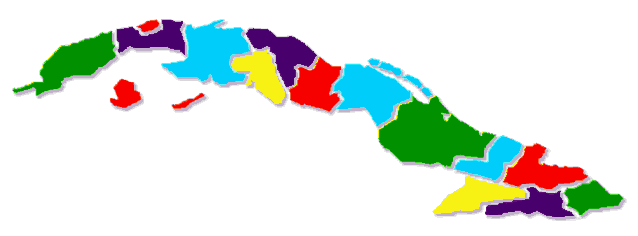 For eleven days,
I found myself on that island bastion of sun, sand and totalitarianism
– Cuba. Less than 100 miles from our shores, it might as well be
another planet. With the U.S. economic embargo in full force, direct
flights from the U.S. to Cuba are impossible.
 Access via third
countries such as Mexico and Canada, however, is a snap. Moreover,
the Cubans are most accommodating by stamping a tourist card, rather than
your U.S. passport, to spare you problems on the return. The following
are some observations I gathered during my brief visit. Clearly,
I merely grazed the surface of this complex and fascinating nation – additional
visits are very much in order.
My musings are organized by general topic. Your can scroll right
through or click on a link immediate below for a specific topic.
Overall Impressions The
Political Economy The Current Economic
Disaster The U.S. Economic Embargo
The Embryonic Private Sector The
Popularity of the Regime Corruption
U.S. Involvement in Cuba Attitudes
Towards Norteamericanos The Future
Overall Impressions
 The impression
from the U.S. is that Cuba is a grim, grey communist outpost in the Caribbean
with an unpleasant dictator at its helm. Well, grim and grey, it
ain’t. Cuba is very much alive. Unspoiled white sand beaches,
regal architecture, perfect weather, fun-loving inhabitants and salsa,
salsa, salsa. It’s hard to believe you’re in a communist country
– it is first and foremost a Latin country. Cuba’s best attraction
is its people – a lively and beautiful mix of black, white and every color
in between who appear to get along very well. They pride themselves
on their Cuban-ness, not their particular background.
 Despite an economy
in collapse, Cubans are easy-going and warm. What little they have,
they share. The streets are not filled with shoeless children beggars,
as is the case in other Latin countries. The kids that I saw looked
well cared for. There is little crime and even less violence.
Rum flows freely and beer is available in vending machines.
It is possible for Western tourists to spend all of their time sequestered
at foreigners-only luxury resorts for what could be a perfect Caribbean
vacation. To do that, however, would be to miss out a country and
a people that are far from perfect, but so much more engaging and real.
Overall Impressions The
Political Economy The Current Economic
Disaster The U.S. Economic Embargo
The Embryonic Private Sector The
Popularity of the Regime Corruption
U.S. Involvement in Cuba Attitudes
Towards Norteamericanos The Future
Political Economy

Cuba is one of the last strongholds of Marxism-Leninism. Its official
currency is the peso. Prices are determined by bureaucratic fiat,
rather than reflecting supply and demand realities. All wages are
paid in pesos, all food staples, mass transit, etc. are peso-denominated.
With 20 pesos to the dollar, the prices in pesos are cheap by Western standards.
For example, a cup of coffee is half a peso, a ham sandwich, three pesos.
These apparently cheap prices aren’t that cheap for Cubans, however.
The average wage is around 200 pesos, or ten dollars. Doctors, lawyers
and engineers do a little better at 250 or 300 pesos. A pound of
chicken is 20 pesos, or ten percent of a monthly paycheck for most.
 As in the former
Soviet Union, cheap prices are good in theory – the reality is that the
peso stores are bereft of products; those that exist are of shoddy quality.
When product is available, long lines form outside the grim little stores.
In the past few years, the U.S. dollar, ironically, has become a nationally
accepted currency. As a result, a two-tiered economy has resulted:
The first is the peso-denominated economy, described above. The second
is the dollar-denominated economy. This is an economy of abundance,
variety and convenience -- provided you have the greenbacks. Prices
in the dollar economy are comparable to prices in the West -- $200
for a mattress, $15 for a compact disk, $195 for a accommodations at a
top-rated hotel.
The problem for Cubans is that beyond rice and beans, everything for
sale is in dollars. So that mattress is a couple of year’s wages.
Obscene!
Overall Impressions The
Political Economy The Current Economic
Disaster The U.S. Economic Embargo
The Embryonic Private Sector The
Popularity of the Regime Corruption
U.S. Involvement in Cuba Attitudes
Towards Norteamericanos The Future
The Current Economic Disaster
If the absurdity of the command economy weren’t disastrous enough, the
demise of the Soviet Union and its petroleum for sugar cane subsidization
of the Cuban economy have sealed its fate. The economy is in a state
of virtual state of collapse.
Food is rationed. Family get a ration book – chicken, pork, sugar,
bread, rice are meted out – when and if they are available. A family
I stayed with in Cienfuegos showed me their book – there were no entries
for chicken or pork for the past three months, as none was available.
Beef is not widely available as cows are dedicated first and foremost to
dairy production. Milk is only available for children under the age
of seven.
Items like shrimp and lobster are harvested exclusively for export for
hard currency and cannot be had legally by Cubans. Of course, fishermen
sometimes divert some of their catch to the black market where they command
reasonable prices, rather than the abysmal prices offered by the State
monopoly. This is risky though. Selling contraband food carries
a 15 year penalty, buying it, 2 years.
As a result, Cubans are raising chickens – everywhere. Even in
a relatively upscale residential section of Havana, I was awakened each
morning by roosters. Private egg production is a necessary pursuit
to supplement the meager protein rations. People have been known
to raise pigs in their apartment bathtubs. They fatten them up for
a few months and then slaughter them. The stench is supposed to be
overwhelming.
Cubans, not surprisingly, are lean. In my eleven days, I didn’t
see a single fat person.
Gasoline is quite expensive for Cubans, about a $1 a liter. This
is especially expensive considering the fuel inefficiencies of the popular
Russian Ladas and 1950s era Chevrolets. During a three hour car ride
from Havana to Cienfuegos, we saw maybe two dozen cars and trucks on one
of the country’s main highways. Not many at all.
Horsedrawn conveyances and bicycles are quite popular. It is not
uncommon to see an entire family riding aboard a single bicycle – dad as
driver, baby on a makeshift seat on the top tube and mom sitting side-saddle
on the back rack, probably holding another kid. I myself was transported
to the central bus station in Cienfuegos via bicycle by my host – with
my rather large carry-on on the handlebars and me on the back rack.
Scooters and small motorcycles, of Russian and Czech origin, are popular.
The motorcycles often have sidecars to make them more of a family transportation
vehicle. It’s a strange sight.
In terms of the physical infrastructure, Cuba is slowly crumbling for
lack of money to maintain its buildings. Havana has some of the fine
architecture – but the paint is peeling, plaster cracking, and, after a
hard rain, roofs collapse. While most structures are still holding
up, others look like Bosnia or Beirut.
Clothing is at a premium. The locally manufactured goods are flimsy
and worthless. I was constantly asked for clothing by Cubans I met
and gave away probably half of the clothes I brought down with me.
Similarly, medicine is nearly none existent. Patients in hospitals
have to buy their medication on the black market. People asked me
for medicine and I donated my ibuprofin and Imodium.
There is a palpable sense of desperation in the streets. Everyone
is hustling to survive and tourists are a key target. It is impossible
to walk down a street without being approached by Cubans offering to be
tours, cigars, lodgings and women. The crisis has turned everyone
into small-time, wheeling-dealing capitalists.
Overall Impressions The
Political Economy The Current Economic
Disaster The U.S. Economic Embargo
The Embryonic Private Sector The
Popularity of the Regime Corruption
U.S. Involvement in Cuba Attitudes
Towards Norteamericanos The Future
The U.S. Economic Embargo
The U.S. economic embargo has only exacerbated this dreadful economic
situation. That said, the embargo has in no way touched the country’s
leadership and the party faithful. They have everything they need.
It is the average people, from professionals, to workers to campesinos
that are suffering. Everyone I met decried the futility and vindictiveness
of the embargo. I was embarrassed by it. During my visit, the
embargo was lifted slightly to allow for humanitarian aid – food and medicine,
a positive step.
Ironically, U.S. products and brands – from Marlboro to Pepsident to
Tabasco – are available everywhere. Generally, these products are
imported from third countries like Panama and Mexico.
The other absurdity of the embargo is that it is clearing the way for
other developed countries to get entrenched in Cuba. Canadian, Mexican
and European concerns are pouring in money and cashing in on the lucrative
tourist trade. When the regime eventually falls, these companies
will be well-positioned in a free economy – when the big money starts rolling
in.
Overall Impressions The
Political Economy The Current Economic
Disaster The U.S. Economic Embargo
The Embryonic Private Sector The
Popularity of the Regime Corruption
U.S. Involvement in Cuba Attitudes
Towards Norteamericanos The Future
Embryonic Private Sector
Along with the legalization of the dollar, small scale free enterprise
has become tolerated. For example, individuals can rent out a spare
room for dollars (casas particulares) or operate private taxis (taxis particulares).
That said, this vanguard of capitalism is subject to heavy taxation by
the bloated bureaucrats. For example, owners of casas particulares
have to pay the government $200 a month – per room, whether they are successful
renting out the room or not. Farmers who farm there own land are
similarly subjected to onerous taxes.
In light of these challenges, many doctors, lawyers and engineers are
now driving cabs and renting out rooms, just to survive.
Foreign companies can and do operate in Cuba, with the State generally
a silent partner skimming off about 50% of profits. Companies can
go independent, but are still subject to usurious tax rates. Still,
it is preferable to having the Government constantly in your face.
While the U.S. economic embargo is obnoxious, it is true that dollars
spent in Cuba do generally go into the Government’s coffers. As such,
I patronized the private enterprisers as much as possible – staying in
casas particulares and using taxis particulares.
Overall Impressions The
Political Economy The Current Economic
Disaster The U.S. Economic Embargo
The Embryonic Private Sector The
Popularity of the Regime Corruption
U.S. Involvement in Cuba Attitudes
Towards Norteamericanos The Future
The Popularity of the Regime
At its inception, the Revolution enjoyed tremendous popularity.
Fidel’s charisma seduced many Cubans of all backgrounds to support the
cause of overthrowing the patently corrupt Batista regime.
 Upon the Revolution’s
victory, it gradually adopted a Marxist-Leninist orientation. This
was initially well-received, but the wholesale confiscation of houses,
real estate properties and businesses hinted at its true nature.
That said, many Cubans were willing to put up with this in the name of
a more egalitarian society. Progress was made on many fronts, including
the highest literacy rate in Latin America, superior and free (in theory)
medical services and education, and high life expectancies.
Fidel has long since institutionalized and bureaucratized the system
which holds a total monopoly on political expression. As in the former
Soviet system, a police state has evolved. Mail is opened and read,
telephones tapped and Internet e-mail and postings closely scrutinized.
Once the bottom fell out when the Soviet system collapsed, Fidel’s popularity
dwindled.
Direct criticism of Fidel is non-existent. A farmer literally
pulled me into a dense coffee tree grove before expressing his opinions
freely. Even then, he didn’t mention Fidel by name, but made hand-gestures
that alluded "the bearded one." Fidel is not loved, he is feared.
Che Guevara, however, does enjoy popular adulation, bordering on the
religious. Not only does his portrait adorn many a party sloganed
billboard, people have portraits of him their homes out of genuine admiration.
Perhaps this is because he represents the revolution in its purest, most
idealistic phase and he never lived to see it corrupted.
Overall Impressions The
Political Economy The Current Economic
Disaster The U.S. Economic Embargo
The Embryonic Private Sector The
Popularity of the Regime Corruption
U.S. Involvement in Cuba Attitudes
Towards Norteamericanos The Future
Corruption
The Cuban regime is not corrupt in the sense of bribe-taking and influence-buying,
as is so common in Latin America and the rest of the developing world.
It is the system itself, where the government has the monopoly on, ironically,
"capitalist" exploitation.
For example, let’s say a foreign company hires a Cuban to work in its
hotel. The company offers the worker a $600 a month salary.
This money, however, is paid directly to the State, which then pays the
worker the same lousy 200 pesos a month and pockets the extra $590 a month
for itself! (Companies recognize this situation and often supplement
salaries with cash under the table.)
The current economic crisis has made day-to-day living extremely difficult,
actually impossible on the average $200 peso/month salary. As such,
most folks are turning to black market enterprises of one kind or another,
thus becoming economic criminals in the eyes of the State.
That said, the party faithful are well cared-for. While they are
still paid in pesos, party members can shop at government stores that are
well-stocked. Moreover, they are given the best housing, utilities,
etc., all for negligible pesos. The U.S. embargo is having no effect
whatsoever on the elite – only the average folks are suffering.
Overall Impressions The
Political Economy The Current Economic
Disaster The U.S. Economic Embargo
The Embryonic Private Sector The
Popularity of the Regime Corruption
U.S. Involvement in Cuba Attitudes
Towards Norteamericanos The Future
U.S. Involvement in Cuba
Unfortunately, the U.S. has a sad legacy in terms of its relationship
with this little island. The Cubans are extremely proud people that have
always wanted to be independent – from Spain, and later from the U.S.
The U.S. consistently has been oblivious to this -- we sided with slave
holders against an independence movement that threatened slavery, intervened
militarily on several occasions, tried to annex or purchase the whole country
outright and sold out their bid for independence at the close of the Spanish-American
War. The U.S. then sided with the country’s repressive and unpopular
regimes, right on down through the highly unpopular Batista. At the
same time, and not coincidentally, U.S. companies dominated the Cuban economy,
owning the phone system, hotels and casinos, major plantations and other
important sectors.
The revolution was the first time in recent history that Cuba broke
free of the U.S. orbit (and then freely embraced the Soviet Union’s orbit!).
The Missile Crisis and Che Guevara’s exhortation to the Third World to
"start 2,000 Vietnams," went beyond mere independence to actually threatening
the U.S. – something small countries don’t often get to do, especially
when their neighbor is a superpower. Talk about the tail wagging
the dog!
In response, the U.S. tried to destabilize the regime, from assassination
attempts of Fidel to the Bay of Pigs Invasion. The Museum of the
Revolution in Havana portrays this legacy in excruciating detail, along
with a vehement running commentary that seems to have "U.S. Imperialism"
in every other sentence.
Whatever their political persuasion, Cubans are not fond of the legacy
of heavy-handed intervention that the U.S. government has pursued.
Overall Impressions The
Political Economy The Current Economic
Disaster The U.S. Economic Embargo
The Embryonic Private Sector The
Popularity of the Regime Corruption
U.S. Involvement in Cuba Attitudes
Towards Norteamericanos The Future
Attitudes Towards Norteamericanos
That said, the regime’s antipathy toward the U.S. government has not
trickled down into hostility to individual American citizens, myself included.
No, the average Cuban is quite fascinated with the U.S. and many are closely
related to the 1.5 million or so Cubans that emigrated to the U.S.
The U.S. dollar is legal tender, baseball is king and hamburger, frankfurters
and pizza are ubiquitous fast goods. Though U.S. television signals
are jammed, U.S. culture seeps in quite freely and legally, be it through
movies and recorded music. While salsa is the established music,
U.S. rap is quite popular.
If and when the regime liberalizes and the U.S. drops the embargo, the
Cubans will not be anxious to go back to the "status quo ante bellum."
There is definitely a fear that some of the less attractive aspects of
the U.S. – drugs, organized crime, violence – will come over as well.
These fears are not entirely baseless and for me were part of the incentive
to visit Cuba sooner rather than later.
Overall Impressions The
Political Economy The Current Economic
Disaster The U.S. Economic Embargo
The Embryonic Private Sector The
Popularity of the Regime Corruption
U.S. Involvement in Cuba Attitudes
Towards Norteamericanos The Future
The Future
While I paint a picture of a country teetering on collapse, the situation
is actually stable, and can proceed in its current painful state for years.
The regime is fully in control -- whether it has the support of the majority
of its citizens is irrelevant. Fidel’s brother, Raul, is currently
being groomed to take center stage after the "bearded one" steps down.
There is no indication that he has any interest in liberalization.
While Cubans might complain, albeit quietly, about the regime, there
does not seem to be anything resembling an organized opposition.
The government has a monopoly on the media, on the use of force (Cubans,
in general, do not own arms), and on the tools of repression.
For the immediate future, it appears to me that we in the U.S. should
toss the embargo and engage constructively with Cuba, as we are doing with
other regimes such as Mainland China. By supporting the emerging
private sector and non-governmental bases of power, such as religious organizations,
we can hope to effect change over the long term. But it’s up to the
Cubans to figure it out for themselves. They will not accept something
imposed from abroad.
Overall Impressions The
Political Economy The Current Economic
Disaster The U.S. Economic Embargo
The Embryonic Private Sector The
Popularity of the Regime Corruption
U.S. Involvement in Cuba Attitudes
Towards Norteamericanos The Future